Ciano at Salzburg
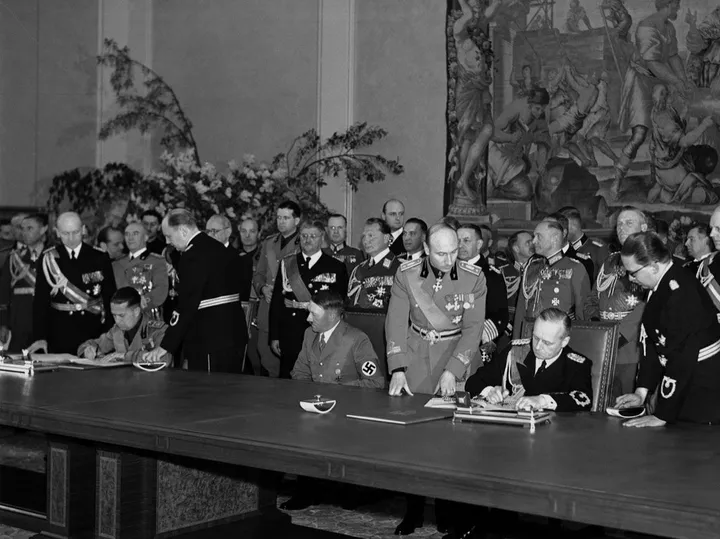
In the second week of August 1939, Galeazzo Ciano boarded a train for Salzburg. He was Italy’s foreign minister, thirty-six years old, and he was traveling at his German counterpart’s invitation for what he expected to be a routine consultation between allies. The Pact of Steel — Italy’s binding military alliance with Germany — had been signed less than three months earlier, in a ceremony at the New Reich Chancellery in Berlin. The Germans had assured the Italians at the time that they wanted, and needed, at least three years of peace.
Ciano would learn within the first hour of his visit that this was no longer the German position, if it had ever been.
At Castle Fuschl
The Italian delegation was received on 11 August 1939 at Castle Fuschl, an estate outside Salzburg that Joachim von Ribbentrop had appropriated as his country residence. The previous owner, an Austrian noble who had protested the expropriation, was at that moment imprisoned at Dachau, where he would die before the end of the month. Ciano knew the story; it did not improve his mood. He had been skeptical of the German alliance for some time, and had spent the months since the Pact of Steel privately telling Italian colleagues that he believed the Germans intended to drag Italy into a war it could not afford.
Before the formal session began, while the two foreign ministers were waiting to sit down to lunch, Ribbentrop told Ciano that Germany had decided to settle its dispute with Poland by force. When Ciano asked what, exactly, Germany was after — the city of Danzig, the Polish Corridor, both — Ribbentrop replied with a phrase that would survive in every history of the war’s origins.
We want war.
Two days at Obersalzberg
On 12 and 13 August, Ciano was driven to Obersalzberg, in the Bavarian Alps, for two meetings with Hitler at the Berghof. Hitler delivered the same message at greater length and with increasing animation: Poland would be eliminated as a state in a matter of weeks; Britain and France, despite their guarantees to Warsaw, would not fight; the Axis would emerge from the operation strengthened. Ciano, who had read the cabled assessments of his ambassadors in London and Paris, knew that the British and French intentions were almost certainly the opposite of what Hitler was describing.
He returned to Rome convinced that the Germans were committed to war, that they would not be talked out of it on any terms, and that Italy was not in a position to fight one. The diary entries he wrote during and immediately after the trip are among the most cited in the entire body of his work. He recorded that the German decision to attack was, in his judgment, settled and unalterable. He recorded that even the maximum concessions imaginable would not prevent it; the Germans, he believed, were now governed by something other than rational calculation.
What followed
Mussolini wavered. He was inclined, by temperament and by twenty years of fascist rhetoric, to enter the war on Germany’s side immediately. Ciano spent the last two weeks of August trying to persuade him otherwise. On 1 September, the German army crossed into Poland; on 3 September, Britain and France declared war. Italy did not join. Mussolini issued a statement of “non-belligerency,” a term Ciano had pressed on him as preferable to the more honest “neutrality.”
The reprieve lasted nine months. Italy entered the war on 10 June 1940, as France was on the point of collapse, in what Ciano regarded — and recorded — as an unforced and disastrous error. The diary entries from August 1939, with their record of Italy’s last meaningful chance to stay out, would later be quoted at the Nuremberg trials as evidence against Ribbentrop, who was convicted and hanged in 1946 in part on the strength of the conversations he had held with Ciano at Castle Fuschl.